
Introduction
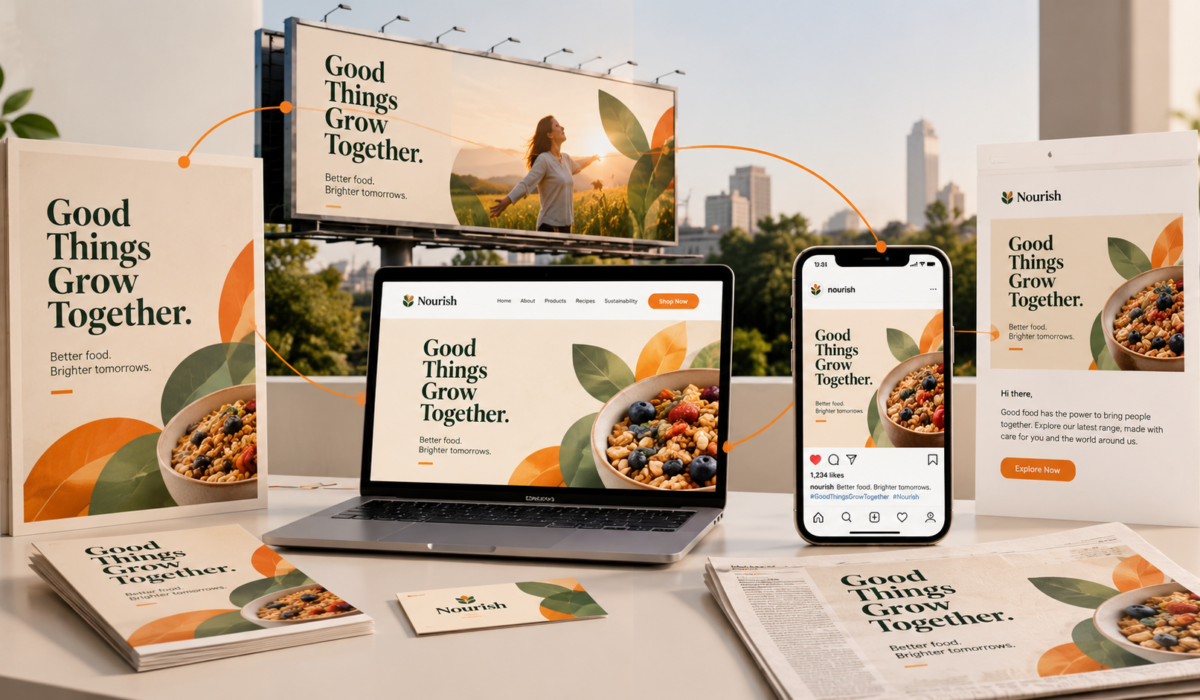
Your audience might discover your brand through an Instagram post, read about your products on your website, see your advertisement in a newspaper, and eventually contact your sales team. But what happens when each interaction feels like it belongs to a different brand?
Disconnected marketing can confuse customers, weaken brand recognition, and make it harder for businesses to communicate their value.
This is where an integrated marketing campaign makes a difference.
Instead of treating advertising, social media, print, email, websites, and other marketing activities as separate efforts, an integrated campaign brings them together under one strategy, one core message, and a shared business objective.
For businesses looking to strengthen their brand presence and generate meaningful customer engagement, integration is not simply about being present on more platforms. It is about making every marketing touchpoint work together.
In this guide, we explore what integrated marketing campaigns are, how they work, their key benefits, practical examples, and the steps businesses can follow to plan an effective campaign.
What Is an Integrated Marketing Campaign?
An integrated marketing campaign is a coordinated marketing initiative that uses multiple communication channels to deliver a consistent message and create a connected brand experience.
These channels can include:
- Print advertisements and brochures
- Social media content and advertising
- Websites and landing pages
- Email marketing campaigns
- Digital advertising and search marketing
- Video production and content marketing
- Outdoor advertising and in-store experiences
- Events, public relations, and promotional materials
The defining characteristic is not the number of channels used. It is how effectively they work together.
For example, imagine a retail brand launching a festive shopping campaign. The brand develops a central campaign idea and carries it across newspaper advertisements, social media posts, in-store displays, digital ads, and its website.
Each execution is adapted to suit its channel, but the messaging, visual identity, and overall objective remain connected.
A customer encountering the campaign in different places receives a consistent impression of the brand.
That is the purpose of integrated marketing.
How Does an Integrated Marketing Campaign Work?
An integrated campaign begins with a clear business objective and a central creative idea. Every marketing activity is then planned to support that idea.
The process typically follows five stages.
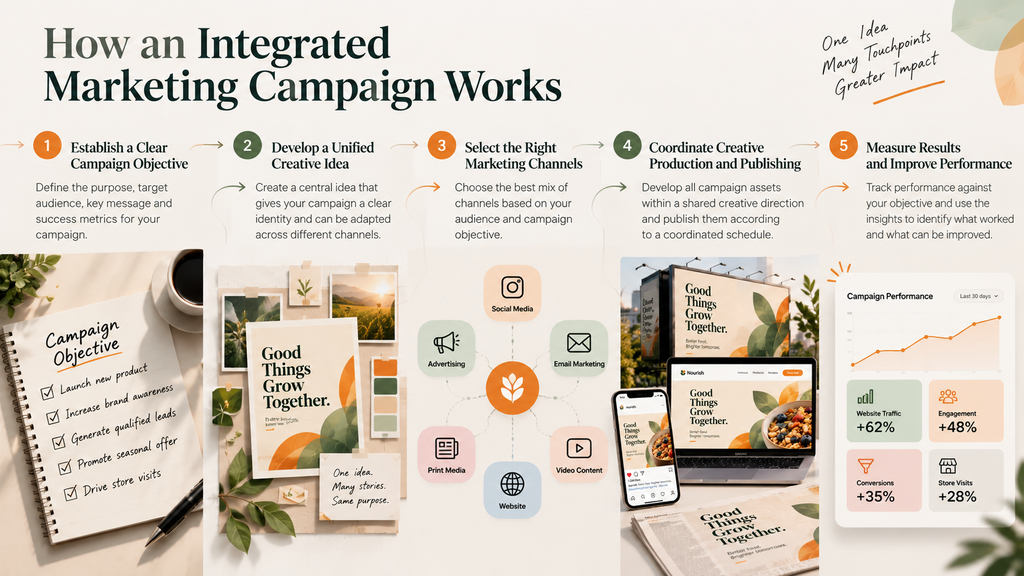
1. Establish a Clear Campaign Objective
Every campaign needs a defined purpose. A business might want to launch a new product, increase brand awareness, generate qualified leads, promote a seasonal offer, or drive customers to a physical store.
The objective determines the campaign’s message, audience, channels, budget, and performance indicators.
2. Develop a Unified Creative Idea
The creative concept gives the campaign its identity. It could be a memorable headline, a visual theme, a brand story, or a specific customer benefit.
This idea should be flexible enough to work across different formats without losing its meaning.
3. Select the Right Marketing Channels
Different channels serve different purposes.
Social media can generate engagement, search marketing can help people discover a solution, print advertising can reach relevant audiences, and a landing page can provide the information needed to take action.
The channel mix should reflect the target audience and campaign objective rather than a desire to be everywhere.
4. Coordinate Creative Production and Publishing
The campaign’s visual assets, copy, advertising materials, website content, and social media posts should be developed within a shared creative direction.
A coordinated schedule helps ensure that each channel supports the campaign at the right time.
5. Measure Results and Improve Performance
Campaign performance should be evaluated against the original objective.
Depending on the campaign, this could include website traffic, engagement, enquiries, conversion rates, store visits, or sales.
The findings help marketers identify what worked, where customers responded, and what should be improved.
What Are the Benefits of an Integrated Marketing Campaign?
A well-planned integrated marketing campaign can help businesses communicate more consistently, use creative resources efficiently, and create a more connected customer journey.
1. Stronger Brand Recognition
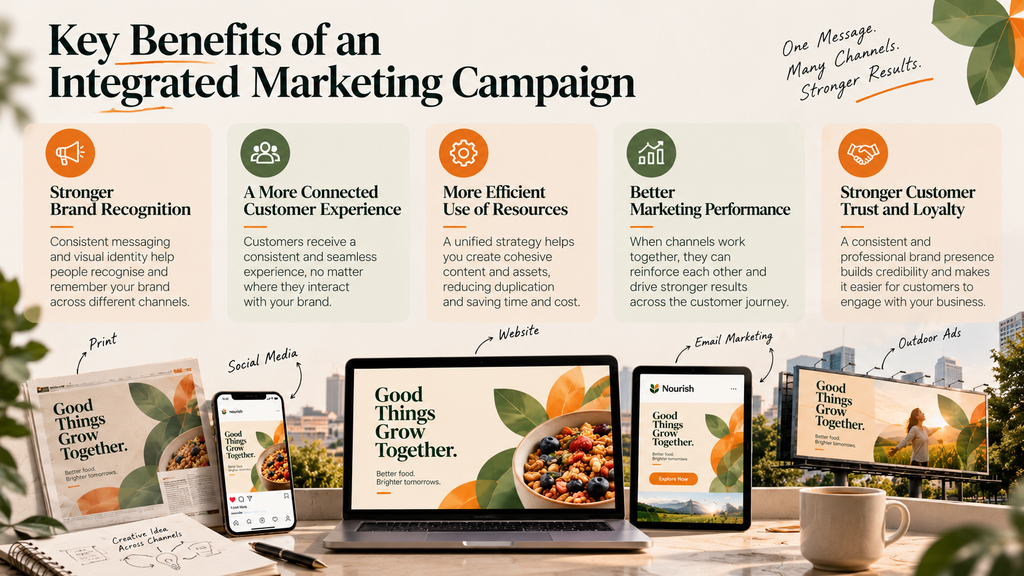
Consistent messaging, visual identity, and brand voice help people recognise a business across different channels.
When customers repeatedly encounter a connected campaign, its core message becomes easier to identify and remember.
2. A More Connected Customer Experience
Customers rarely follow a perfectly predictable path from discovering a brand to making a purchase.
Someone might encounter a social media advertisement, visit the website later, and then respond to an email.
Integrated marketing helps these interactions feel connected rather than isolated.
3. Better Use of Creative Resources
A central campaign concept can inform multiple creative outputs, including advertisements, social media content, videos, email graphics, and website assets.
This allows businesses to adapt approved creative materials for different formats instead of developing every execution independently.
The result can be a more efficient creative production process.
4. More Effective Communication Across Channels
Each marketing channel has different strengths. Integration allows businesses to use those strengths in a coordinated way.
A print advertisement might create awareness, a social media campaign might encourage participation, and a website might provide detailed information and a clear conversion path.
Together, these activities can support a more complete marketing journey.
5. Clearer Campaign Measurement
When campaign objectives and tracking methods are established from the beginning, businesses can evaluate performance more systematically.
Tracking links, campaign-specific landing pages, enquiry forms, and analytics tools can help identify which channels contribute to results.
It is important to remember that integrated marketing does not automatically guarantee higher sales or lower costs. Results depend on the quality of the strategy, execution, audience fit, and measurement.
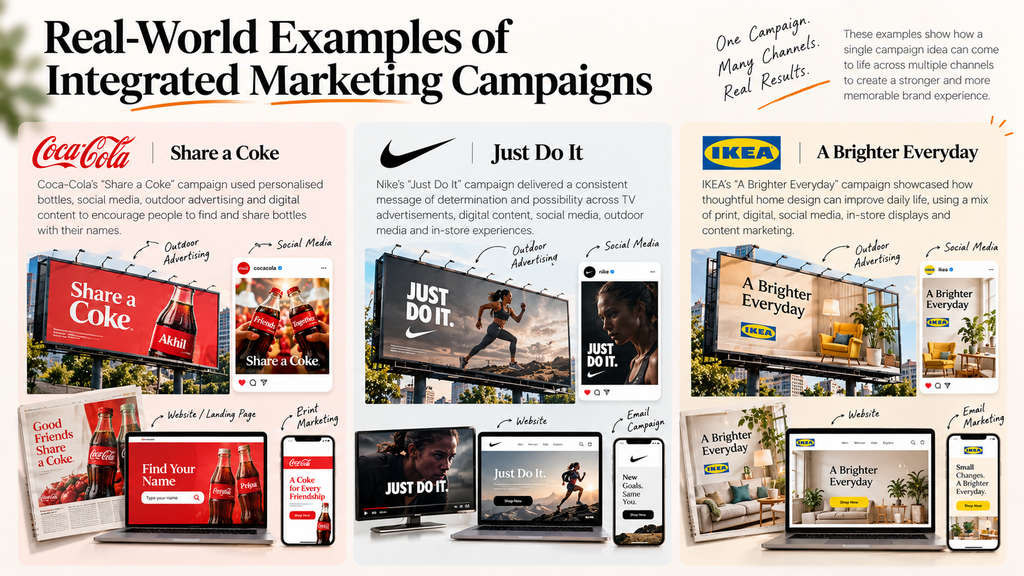
5 Integrated Marketing Campaign Examples
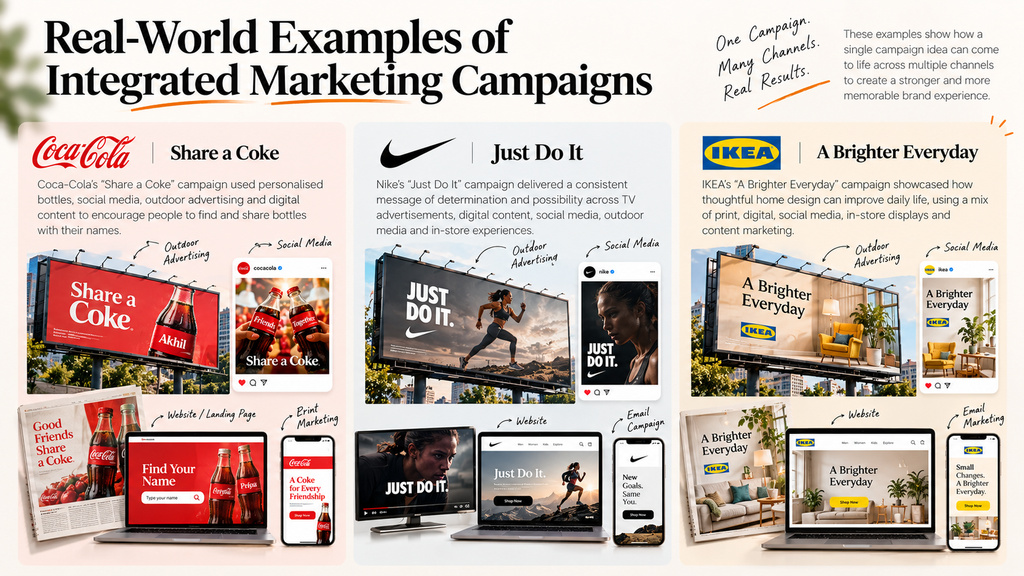
The following examples illustrate how a business could connect different marketing channels around a single objective.
Example 1: Festive Retail Campaign
Objective: Increase festive-season visits and shopping activity at a shopping mall.
A mall develops a festive campaign built around a central message such as “Shop, Celebrate, Win.”
The campaign could include:
- Newspaper advertisements announcing the festive offer.
- Social media posts highlighting promotions and festive installations.
- Short-form videos showcasing the shopping experience.
- Website updates containing campaign details.
- In-mall displays reinforcing the campaign identity.
- QR codes connecting offline advertising to the mall’s social media page.
The newspaper ad creates awareness, social content gives people reasons to engage, and the physical experience brings the campaign to life.
All these touchpoints reinforce the same campaign idea while serving different purposes.
Example 2: New Product Launch
Objective: Introduce a new consumer product and encourage potential customers to explore it.
A product brand creates a launch campaign centred on a specific customer benefit.
The integrated execution might include:
- Product packaging and launch visuals.
- A landing page explaining the product’s features.
- Social media teasers and demonstration videos.
- Digital advertisements targeting relevant audiences.
- Email announcements to existing customers.
- Retail display materials and promotional brochures.
The packaging establishes the product’s identity, the advertising attracts attention, and the landing page provides the information customers need to evaluate the product.
The campaign works as a connected system rather than a collection of unrelated promotional materials.
Example 3: B2B Brand Awareness Campaign
Objective: Build awareness and generate enquiries from decision-makers in a specific industry.
An industrial technology company wants to communicate a complex product offering to business buyers.
Its campaign could combine:
- A clear product positioning strategy.
- Technical brochures and sales presentations.
- CGI product visualisation and explainer videos.
- LinkedIn content and targeted advertising.
- Website pages addressing customer challenges.
- Email outreach and industry event materials.
The central message remains consistent, but the level of detail changes according to the audience and channel.
A short social media post may introduce the problem, while a technical brochure explains the solution in greater depth.
Example 4: Website Redesign and Digital Campaign
Objective: Generate qualified enquiries for a professional service.
A company redesigns its website but also needs to attract relevant visitors to it.
An integrated campaign could connect:
- A refreshed brand identity and website design.
- Search-optimised service pages.
- Educational blog articles.
- Social media posts sharing useful insights.
- Paid search campaigns targeting relevant queries.
- Email campaigns directing interested prospects to dedicated landing pages.
The website becomes the central destination, while content and advertising help bring relevant audiences to it.
Success is measured not only by website visits but also by the quality and number of enquiries generated.
Example 5: Seasonal Brand Campaign
Objective: Increase awareness and encourage purchases during a seasonal promotion.
A lifestyle brand develops a campaign around a seasonal theme and adapts it across its marketing channels.
The same creative direction informs social media graphics, product photography, email promotions, website banners, packaging inserts, and retail materials.
Customers can recognise the campaign wherever they encounter it.
This approach is particularly useful when a business needs to communicate a time-sensitive offer across several customer touchpoints.
Integrated Marketing vs. Multichannel Marketing
The terms are related, but they are not identical.
Multichannel marketing means using multiple channels to reach customers. Integrated marketing places additional emphasis on coordinating those channels around a shared strategy and consistent customer experience.
Consider the difference:
Multichannel approach: A business runs social media ads, sends promotional emails, and publishes newspaper advertisements, but each activity is planned independently.
Integrated approach: The business uses the same campaign objective and core creative idea to coordinate its advertisements, emails, social content, website messaging, and customer journey.
A campaign can use many channels without being properly integrated. The strategy connecting those channels is what matters.
How to Plan an Integrated Marketing Campaign: A Step-by-Step Guide
Businesses do not need to use every available marketing channel to create an effective integrated campaign. They need to choose the right channels and coordinate them around a clearly defined objective.
Step 1: Define Your Business Goal
Start by identifying what the campaign must achieve.
Examples include:
- Increasing awareness of a new brand.
- Generating qualified sales enquiries.
- Launching a product.
- Driving footfall to a retail location.
- Promoting a seasonal offer.
- Improving customer retention.
Make the objective specific and measurable wherever possible.
For instance, instead of saying “increase website traffic,” define the audience, timeframe, and relevant traffic or conversion target.
Step 2: Understand Your Target Audience
Research your audience’s needs, preferences, challenges, and decision-making process.
Ask questions such as:
- Who are we trying to reach?
- What problem are they trying to solve?
- What information do they need before making a decision?
- Where are they most likely to discover or evaluate our offering?
- What might prevent them from taking action?
These insights help determine the campaign message and channel selection.
Step 3: Create the Central Campaign Message
Develop one clear proposition that explains why the campaign matters to the audience.
The message should be relevant to the business objective and simple enough to translate into different formats.
Create a shared creative direction covering the campaign headline, key messages, visual identity, tone of voice, and calls to action.
Consistency does not mean repeating identical copy everywhere. It means preserving the same underlying idea while adapting its presentation.
Step 4: Choose the Right Channel Mix
Select channels based on audience behaviour, budget, and campaign requirements.
For example:
| Channel | Potential role |
|---|---|
| Website or landing page | Explain the offer and convert visitors |
| Social media | Build awareness and engagement |
| Search marketing | Capture relevant search demand |
| Email marketing | Nurture interested prospects |
| Print advertising | Reach relevant offline audiences |
| Video and CGI | Demonstrate products or communicate complex ideas |
| Events and physical displays | Create direct, real-world experiences |
Use only the channels that contribute meaningfully to the campaign objective.
Step 5: Develop the Creative Assets
Plan the assets required for every channel before production begins.
These may include campaign key visuals, social media formats, advertisements, landing pages, videos, email templates, brochures, and packaging.
Create a common set of brand and campaign guidelines so that different assets remain visually and verbally consistent.
This is also the stage where creative, content, digital, and production teams need to coordinate closely.
Step 6: Build a Campaign Calendar
Map out the campaign timeline from initial awareness to the final call to action.
A simple sequence could be:
Teaser → Launch → Engagement → Consideration → Conversion → Evaluation
The sequence will vary by campaign. A retail promotion might have a short launch period, while a B2B campaign may require several weeks of educational content and lead nurturing.
Ensure that landing pages, creative assets, tracking links, and campaign messaging are ready before launch.
Step 7: Measure Performance
Define the metrics that matter before the campaign goes live.
| Objective | Possible metrics |
|---|---|
| Brand awareness | Reach, impressions, branded search activity |
| Audience engagement | Engagement rate, video completion, content interactions |
| Website acquisition | Relevant sessions, traffic sources, landing-page visits |
| Lead generation | Enquiries, qualified leads, cost per lead |
| Sales | Conversions, revenue, cost per acquisition |
| Retail footfall | Tracked visits, offer redemptions, campaign-specific responses |
Use campaign-specific URLs, UTM parameters, analytics, CRM records, and conversion tracking where appropriate.
Not every outcome can be attributed perfectly to one channel. Use the available data to understand channel contributions rather than assuming that every conversion came from the last advertisement a customer clicked.
Step 8: Optimise and Learn
Review performance throughout the campaign.
Identify which messages attract attention, which channels bring qualified visitors, and where potential customers abandon the journey.
Adjust creative assets, audience targeting, channel allocation, or landing pages based on evidence.
After the campaign ends, document the findings so that future campaigns can build on what worked.
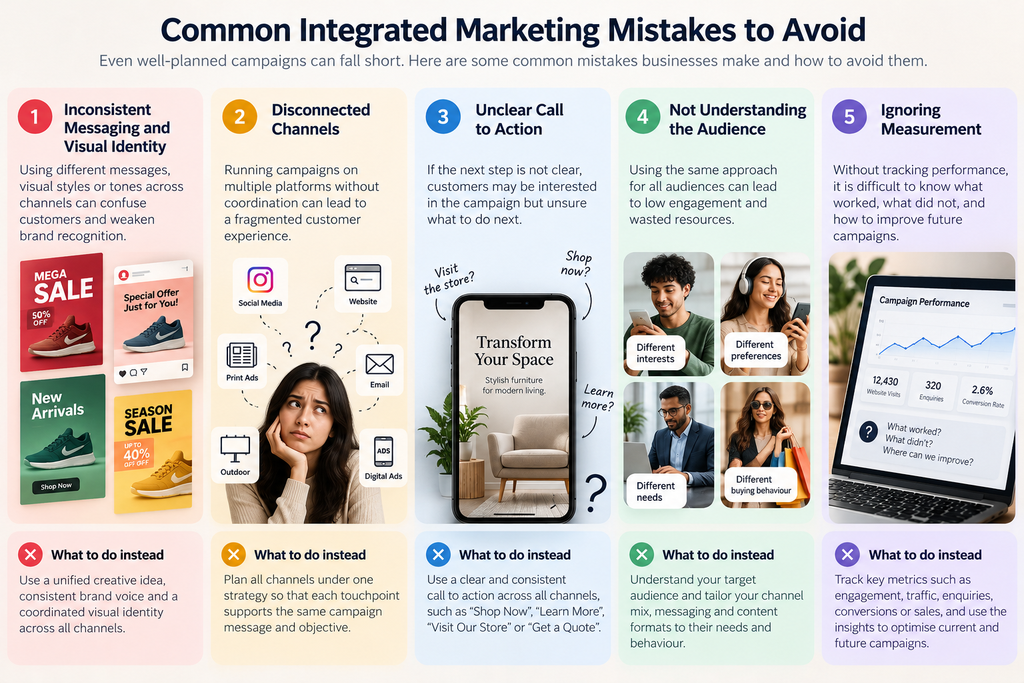
Common Integrated Marketing Mistakes to Avoid
Even a campaign using multiple channels can underperform if the planning and execution are disconnected.
Using inconsistent messaging: Different headlines, offers, or brand promises can confuse customers.
Choosing too many channels: Being present everywhere can spread budgets and resources too thinly. Prioritise channels based on the audience and objective.
Treating creative assets as afterthoughts: A strong strategy needs equally strong execution across the formats where the audience encounters it.
Ignoring the landing-page experience: Advertising can generate interest, but a confusing or irrelevant destination may prevent visitors from taking action.
Measuring only vanity metrics: Impressions and likes can provide useful context, but they do not necessarily demonstrate business impact.
Failing to coordinate teams: Creative, content, digital, and sales teams need shared objectives, timelines, and responsibilities.
How a Creative Agency Can Help Build an Integrated Campaign
An integrated campaign requires more than producing individual advertisements or social media posts. It requires a connected approach to strategy, creative development, content, design, production, and execution.
A creative agency can help businesses translate their objectives into a campaign concept and then adapt that concept across relevant touchpoints.
This can involve brand messaging, campaign identity, print and marketing collateral, website development, social media creatives, content development, campaign mailers, product packaging, and visual production.
The value comes from bringing these activities together under a common direction while ensuring that each asset fulfils its intended role.
At SparkPro Creatives, the opportunity is to help brands move beyond disconnected creative outputs and develop cohesive brand and campaign experiences across channels.
Whether a business is preparing for a product launch, developing a seasonal campaign, refreshing its website, or strengthening its brand identity, the starting point should always be the same: understand the objective, define the audience, and build the creative strategy around what the business needs to achieve.
Frequently Asked Questions
What is the main purpose of an integrated marketing campaign?
The main purpose is to coordinate marketing channels around a shared objective and consistent core message, creating a connected brand experience and supporting measurable business outcomes.
What are the main components of an integrated marketing campaign?
Common components include campaign objectives, audience research, a central creative idea, coordinated messaging, channel selection, creative assets, a publishing calendar, and performance measurement.
Which channels can be used in an integrated marketing campaign?
Depending on the audience and objective, channels may include social media, websites, email, search advertising, print, video, public relations, events, and physical retail experiences.
Is integrated marketing suitable for small businesses?
Yes. Small businesses can integrate a few carefully selected channels without requiring a large budget. A consistent message across a website, social media, email, and relevant local advertising can be a practical starting point.
How do you measure an integrated marketing campaign?
Measurement depends on the objective. Businesses can track reach, engagement, website sessions, enquiries, qualified leads, conversions, sales, and acquisition costs using suitable analytics and tracking tools.
What is the difference between integrated marketing and omnichannel marketing?
Integrated marketing focuses on coordinating messages and campaigns across channels. Omnichannel marketing places greater emphasis on creating a connected customer experience across interactions, often including continuity between digital and physical environments. The concepts overlap, but their emphasis differs.
Conclusion: Make Every Marketing Touchpoint Work Together
An integrated marketing campaign is not about publishing the same content across every platform. It is about creating a connected strategy in which every channel contributes to the same business goal.
When the message, creative direction, customer journey, and measurement framework work together, businesses can communicate more clearly and make better use of their marketing resources.
The most effective campaigns begin with a simple question: what do we want our audience to understand, feel, or do?
Once that is clear, every advertisement, website page, social post, email, and physical interaction can be designed to support that objective.
Planning your next brand or marketing campaign?
Explore how SparkPro Creatives can help bring your brand strategy, creative development, and campaign communication together.
Frequently Asked Questions
1. What is an integrated marketing campaign?
An integrated marketing campaign is a coordinated marketing strategy that uses multiple channels, such as social media, websites, email, print advertising, and digital campaigns, to communicate a consistent message and achieve a shared business objective.
2. What are the main benefits of integrated marketing campaigns?
Integrated marketing campaigns help strengthen brand recognition, create a consistent customer experience, improve coordination between marketing channels, make better use of creative resources, and measure campaign performance more effectively.
3. What are some examples of integrated marketing campaigns?
Examples include festive retail promotions combining newspaper advertisements, social media, and in-store displays; product launches connecting packaging, videos, websites, and email; and B2B campaigns using brochures, LinkedIn content, CGI videos, and landing pages.
4. What is the difference between integrated marketing and multichannel marketing?
Multichannel marketing uses several channels to reach customers. Integrated marketing coordinates those channels around a shared strategy, consistent messaging, and a connected customer experience.
5. How do you plan an integrated marketing campaign?
Start by defining your business objective and target audience. Develop a central campaign message, select relevant channels, create consistent assets, establish a campaign calendar, and measure results against your objectives.
6. Which channels should an integrated marketing campaign include?
The right channels depend on your audience, budget, and goals. Options include social media, websites, email marketing, search advertising, print, video, packaging, outdoor advertising, and events.
7. How do you measure the success of an integrated marketing campaign?
Success can be measured through reach, engagement, website traffic, qualified enquiries, conversion rates, sales, and customer acquisition costs. Choose metrics that directly relate to your campaign objectives.
8. Are integrated marketing campaigns suitable for small businesses?
Yes. Small businesses can coordinate a few relevant channels, such as their website, social media, email, and local advertising, around one consistent message without needing a large marketing budget.
9. How can a creative agency help with integrated marketing?
A creative agency can help develop the campaign concept, establish visual consistency, create marketing assets, and coordinate communication across relevant channels. Services may include branding, website development, packaging, print design, content, and campaign creative.
10. How can SparkPro Creatives help with an integrated marketing campaign?
SparkPro Creatives offers creative services spanning branding, website development, marketing collateral, content development, campaign mailers, packaging, and visual communication.
Explore the services and portfolio at www.sparkprocreatives.com to discover how SparkPro Creatives can support your next branding or marketing campaign.
Planning your next marketing campaign?
Visit SparkPro Creatives to explore our creative services and discuss your project.
Leave a Reply