
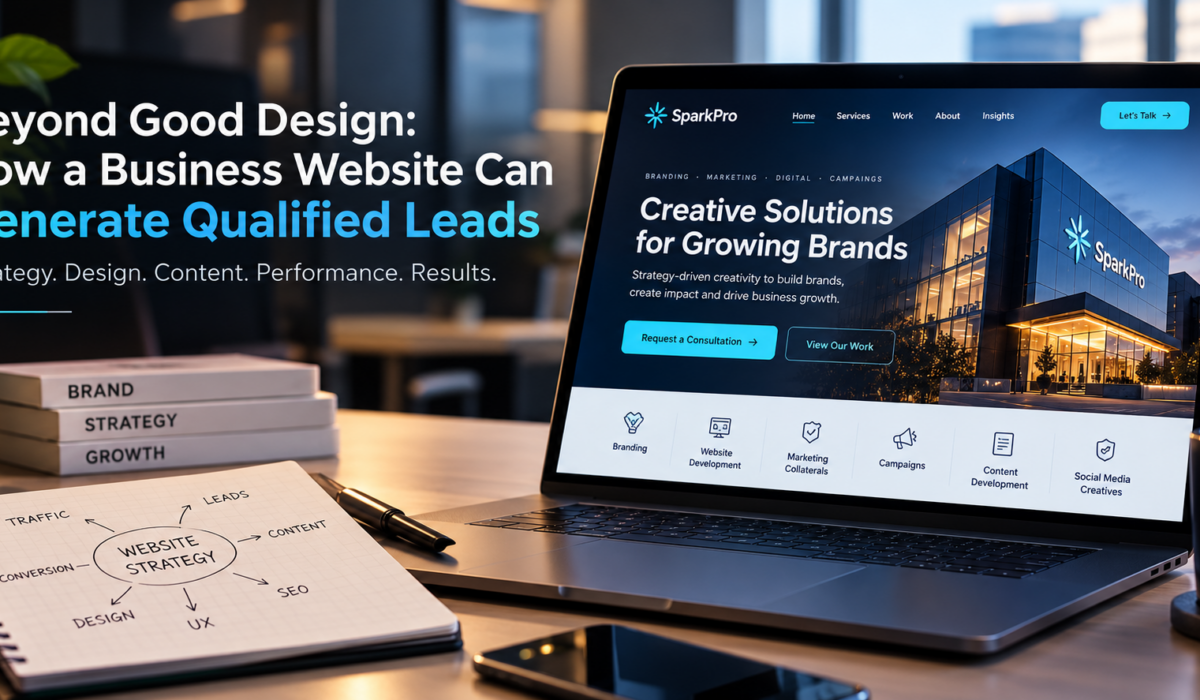
A visually appealing website can create a strong first impression. But does it turn visitors into potential customers?
For many businesses, a website serves as a digital brochure—showcasing services, displaying a portfolio and sharing contact details. While these elements are important, they don’t necessarily encourage visitors to take the next step.
A high-performing business website does more than look professional. It communicates value, builds trust, answers customer questions and guides the right audience towards meaningful action.
Whether you’re a startup, an established B2B company or a growing consumer brand, your website can become an important part of your lead generation strategy when design, content, user experience and search visibility work together.
In this guide, we’ll explore how businesses can turn their websites into more effective tools for attracting and converting qualified leads.
1. Start with a Clear Website Strategy
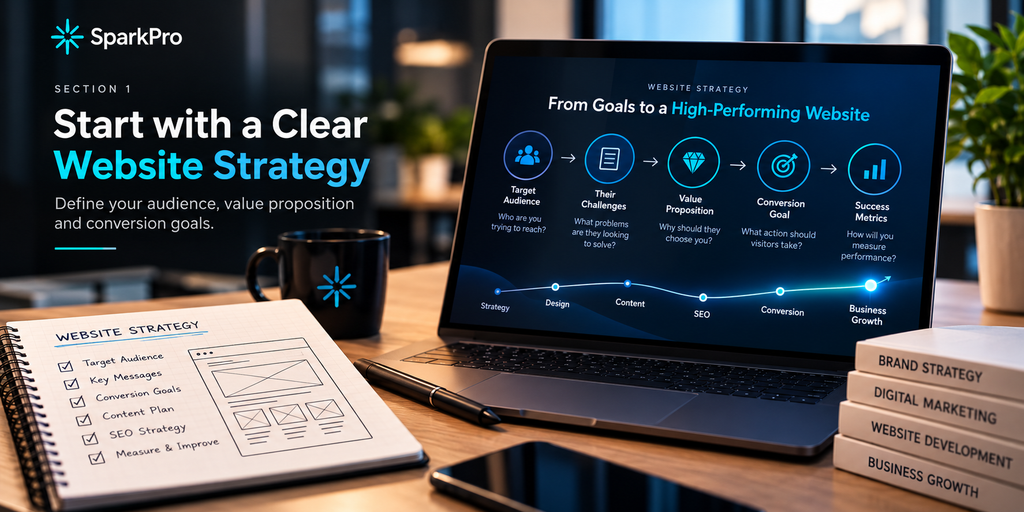
Before thinking about colours, animations or layouts, identify what your website needs to achieve.
Is your primary goal to generate enquiries, schedule consultations, request product demonstrations, sell products or attract channel partners? Each objective requires a different approach.
For example, a B2B technology company might need visitors to request a product demo, while a creative agency might want prospective clients to book a discovery call.
Your website should be designed around these business goals.
Start by defining:
- Your target audience: Who are you trying to reach?
- Their challenges: What problems are they looking to solve?
- Your value proposition: Why should they choose your business?
- Your conversion goal: What action should visitors take?
- Your success metrics: How will you measure performance?
When these elements are clear, design decisions become more purposeful. Instead of adding features simply because they look impressive, you can prioritise those that help visitors understand your offering and make informed decisions.
2. Make Your Value Proposition Immediately Clear
Visitors should be able to understand what your business does, whom it serves and why it matters without searching through multiple pages.
Your homepage headline plays a crucial role in communicating this information.
Consider the difference between these examples:
Generic headline:
Welcome to Our Company. Delivering Excellence Through Innovation.
More effective headline:
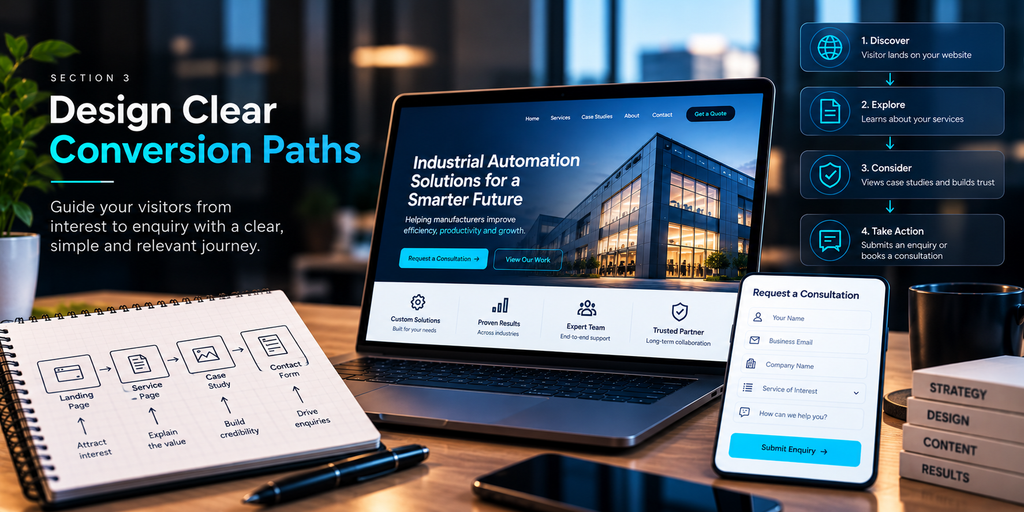
Industrial Automation Solutions That Help Manufacturers Improve Efficiency.
The second example identifies the service, its audience and its potential value.
A strong homepage typically includes:
- A clear, benefit-oriented headline.
- Supporting copy explaining your offering.
- A relevant visual demonstrating your product or service.
- A prominent call to action.
- Trust signals that support your credibility.
Avoid vague statements that could describe almost any business. Specific messaging helps potential customers recognise whether your company is relevant to their needs.
3. Design Clear Conversion Paths
A website can attract visitors and still struggle to generate enquiries if users don’t know what to do next.
This is where conversion-focused design becomes important.
A call to action (CTA) should tell visitors what happens when they click it. Depending on the business, useful CTAs might include:
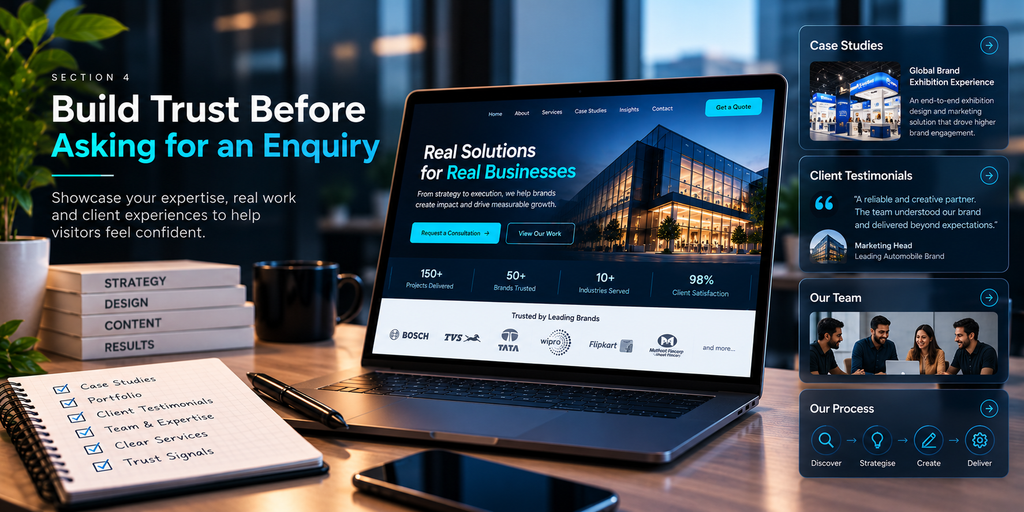
- Request a Consultation
- Book a Product Demo
- Get a Custom Quote
- Explore Our Projects
- Talk to Our Team
The wording should match the visitor’s intent. Someone exploring a service for the first time may prefer to learn more before committing to a sales conversation.
Place relevant CTAs where users naturally need them: after explaining a service, alongside a relevant case study or at the end of a page.
Keep the layout focused, avoid competing calls to action and ensure that buttons are easy to use on mobile devices.
The objective isn’t to push every visitor towards an enquiry immediately. It’s to make the next appropriate step easy to understand and complete.
4. Build Trust Before Asking for an Enquiry
Potential customers often evaluate several providers before making contact. Your website should give them enough information to feel confident about starting a conversation.
Trust isn’t created by visual design alone. It comes from evidence, transparency and consistency.
Consider incorporating:
Relevant case studies: Explain the client’s challenge, your approach and the outcome. Include measurable results only when they can be substantiated.
Portfolio examples: Show work relevant to the services and industries you want to attract.
Client testimonials: Use genuine feedback with permission and accurate attribution.
Team and company information: Help visitors understand the people and expertise behind the business.
Clear service descriptions: Explain deliverables, processes and what clients can expect.
For B2B businesses, detailed project examples can be particularly useful because decision-makers often need to justify their choices to other stakeholders.
A well-presented case study can demonstrate your capabilities more convincingly than a page full of broad claims.
5. Create Service Pages That Answer Real Questions
One common website problem is trying to explain every service on a single page.
When branding, website development, marketing, content creation and other offerings are grouped into a few generic paragraphs, visitors may struggle to find information relevant to their specific needs.
Dedicated service pages provide a better opportunity to explain each offering.
A useful service page should cover:
- The problem the service addresses.
- Who the service is designed for.
- Your approach and process.
- The deliverables or expected scope.
- Relevant examples of your work.
- Frequently asked questions.
- A clear next step.
These pages can also support search engine optimisation (SEO) by addressing specific search queries and user needs.
For example, a business offering website development in Bangalore could create a dedicated page explaining its website design process, technical capabilities, project scope and support options.
The content should be genuinely useful rather than simply repeating a keyword throughout the page.
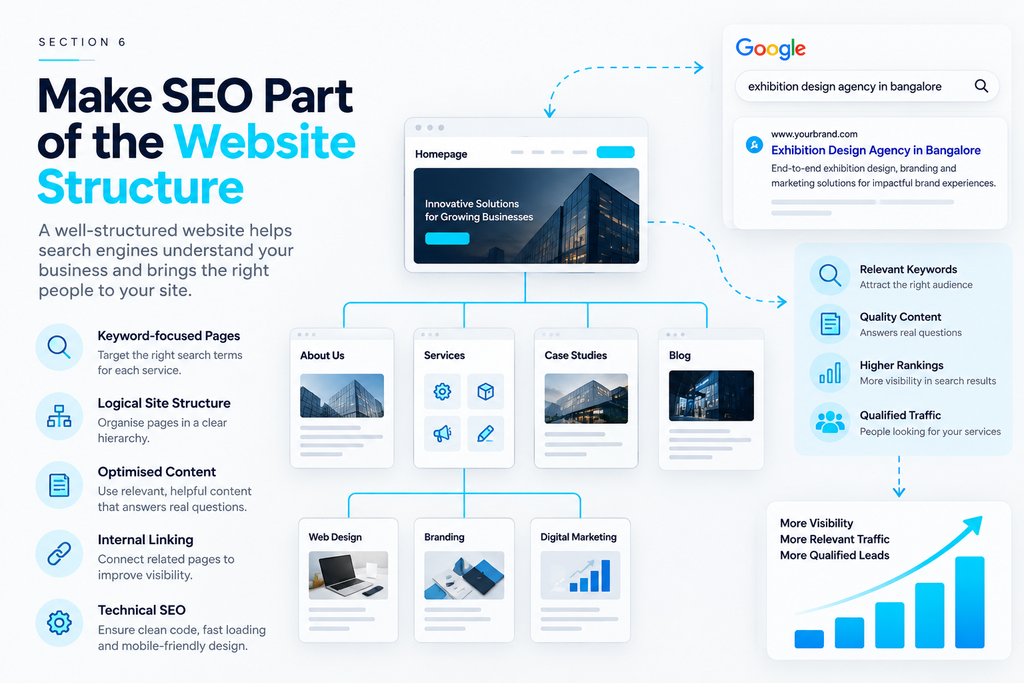
6. Make SEO Part of the Website Structure
A beautiful website won’t generate organic leads consistently if relevant customers cannot discover it.
Search engine optimisation should therefore be considered during website planning and development, rather than added as an afterthought.
Important foundations include:
Keyword and intent research: Understand what prospective customers search for and what they expect to find.
Logical page structure: Organise services, industries, case studies and resources so visitors and search engines can navigate them easily.
Descriptive page titles and headings: Communicate each page’s main subject clearly.
Useful content: Answer genuine customer questions with original, relevant information.
Technical accessibility: Ensure important pages can be crawled and indexed, and resolve technical issues that interfere with discovery.
Performance and mobile usability: Make pages usable across devices and network conditions.
Google’s guidance recommends creating helpful, people-first content and following established SEO fundamentals. No website structure or keyword strategy can guarantee a particular ranking. Google Search Central: Helpful Content.
For businesses serving specific regions, location-relevant service pages can also help address local search intent when the content reflects real services and locations.
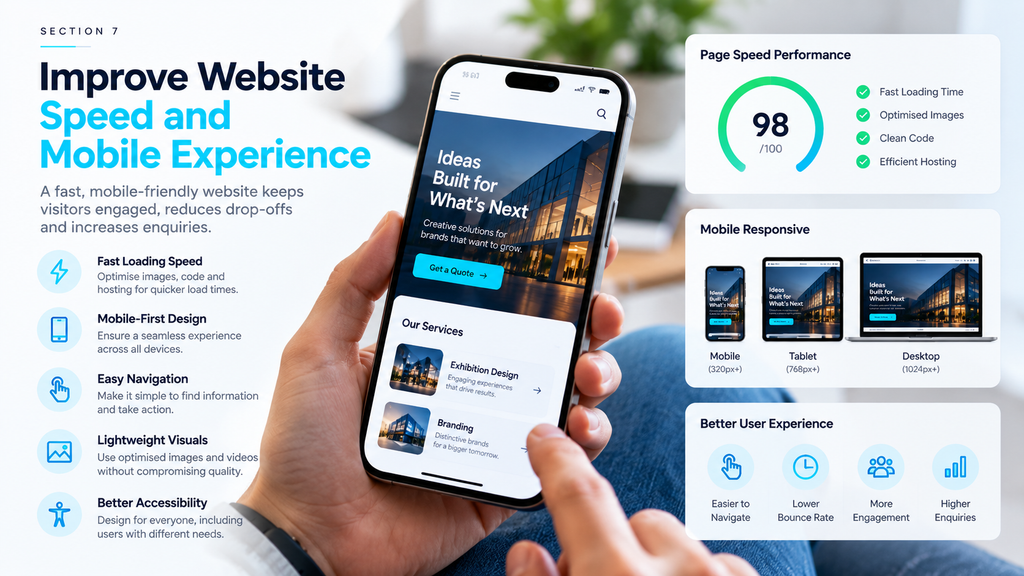
7. Improve Website Speed and Mobile Experience
Visitors shouldn’t have to wait unnecessarily for a page to load or struggle to navigate it on a phone.
Slow pages, intrusive pop-ups, difficult forms and poorly sized text can interrupt the journey from discovery to enquiry.
A better experience starts with practical improvements:
- Compress and optimise images.
- Avoid unnecessary scripts and heavy animations.
- Use readable typography and sufficient contrast.
- Make navigation intuitive.
- Ensure buttons and form fields work well on touchscreens.
- Test important pages on real mobile devices.
- Keep forms as short as the qualification process allows.
Measure real-world performance where possible, using tools such as Google PageSpeed Insights.
For many businesses, the mobile experience deserves particular attention because a prospective customer may first discover a service through a search result, advertisement, social media post or shared link on their phone.
8. Use Lead Forms That Reduce Friction
A lead form should collect enough information to support a useful follow-up without creating unnecessary obstacles.
Asking for too many details at the beginning can discourage enquiries. Asking for too little may make it difficult to understand the prospect’s needs.
Find the right balance for your sales process.
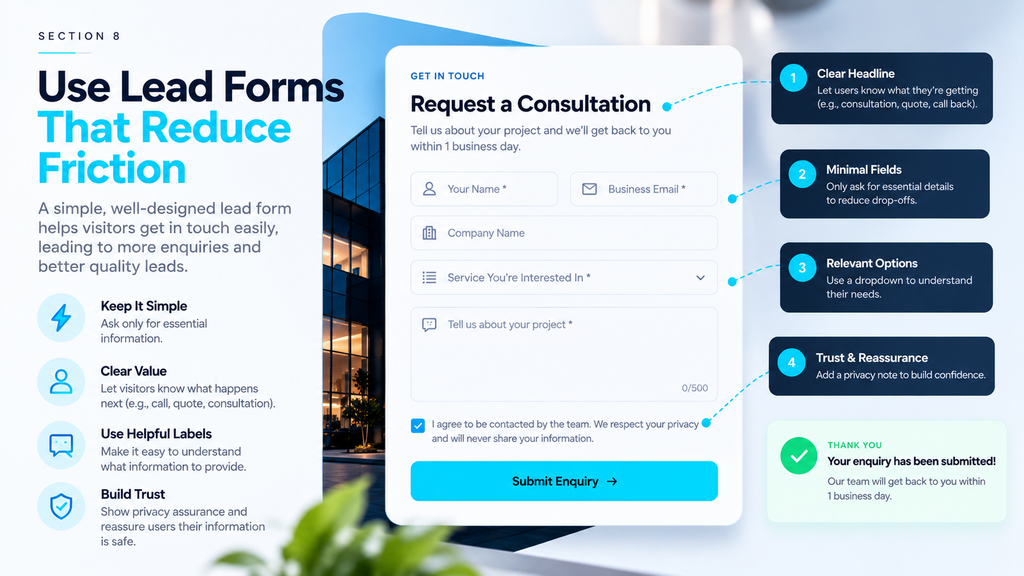
For an initial consultation, a form might request:
- Name
- Business email
- Company name
- Service of interest
- A brief description of the requirement
Additional information can be collected during the conversation if needed.
Make it clear what happens after submission. Explain whether the visitor can expect a call, an email or a consultation.
Also, test the complete process: form validation, submission confirmation, notifications and delivery of enquiries to the appropriate team. A well-designed form is of little value if submissions are lost or never followed up.
9. Measure What Happens After Visitors Arrive
Website traffic is useful, but traffic alone doesn’t tell you whether your website is contributing to business growth.
You need to understand how visitors interact with the site and whether those interactions produce qualified opportunities.
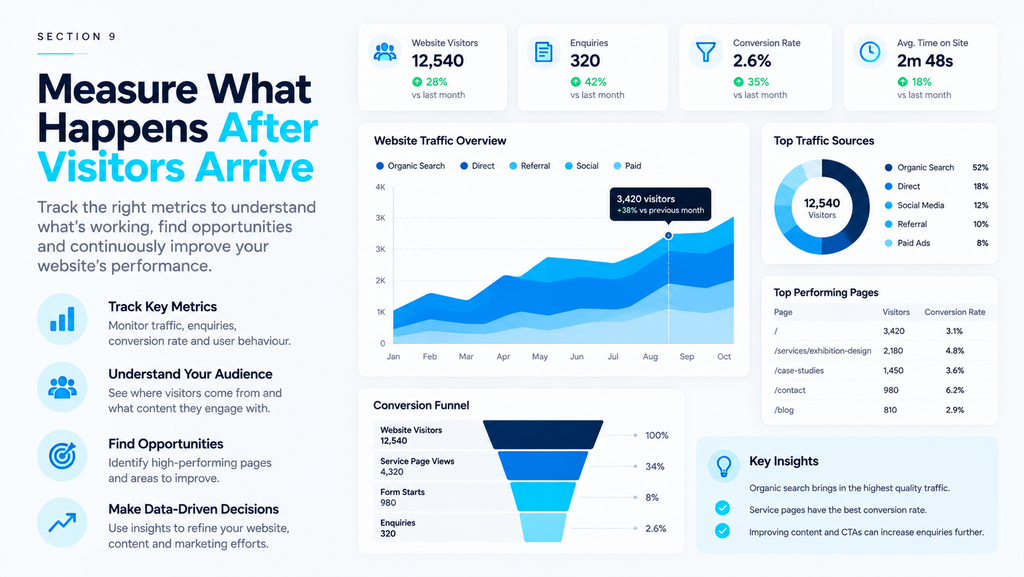
Useful metrics include:
- Conversion rate: The percentage of visitors who complete a defined action.
- Qualified leads: Enquiries that match your target customer profile and requirements.
- Traffic sources: The channels bringing visitors to your website.
- Landing-page performance: The pages that attract visitors and generate conversions.
- Form completion rate: The proportion of visitors who successfully submit a form after starting it.
- Lead-to-customer rate: The proportion of leads that become paying customers.
For example, imagine a website receives 2,000 visits in a month and generates 30 enquiries. Its enquiry conversion rate is 1.5%.
If the website is redesigned and generates 40 enquiries from the same number of visits, the rate becomes 2%.
These figures are illustrative, not industry benchmarks. The actual objective is to improve the quality and commercial value of enquiries, not simply increase the number of form submissions.
Use analytics and CRM data together where possible to understand which pages and channels contribute to qualified leads.
10. Connect Your Website to Your Marketing Activities
Your website shouldn’t operate independently from the rest of your marketing.
Social media campaigns, paid advertising, email outreach, search content and offline campaigns should lead visitors to relevant pages that continue the same message.
For instance, an advertisement promoting a specific service should ideally direct users to a relevant landing page rather than a generic homepage.
That landing page should reinforce the campaign’s promise, provide supporting information and offer a clear next step.
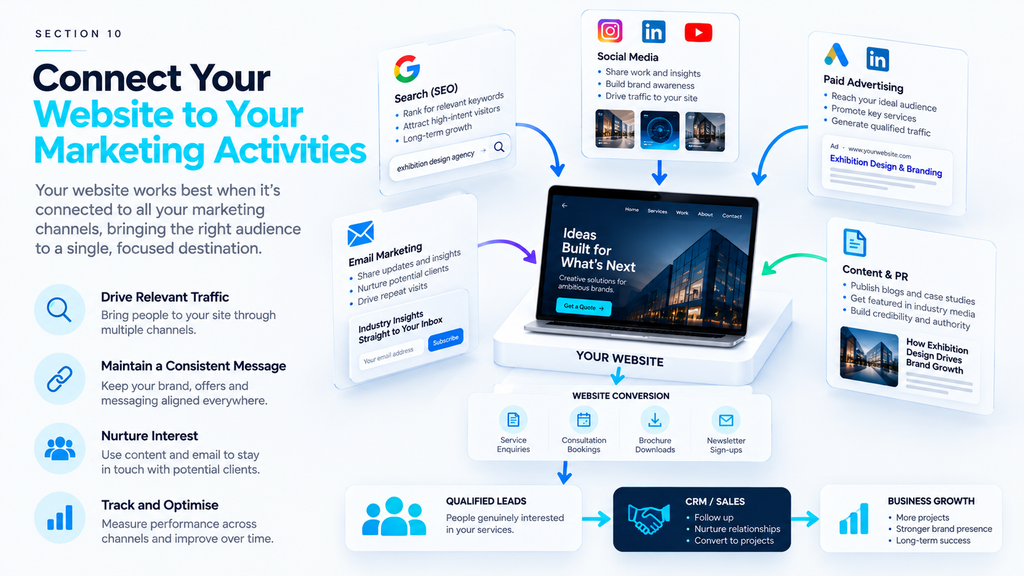
This consistency helps visitors move from discovering your brand to understanding your offer and considering an enquiry.
It also makes performance easier to evaluate because you can compare the results of individual campaigns and landing pages.
Final Thoughts: Build a Website That Works for Your Business
A business website should be more than a digital showcase. It should help the right customers discover your brand, understand your offering, evaluate your credibility and take the next step.
Achieving this requires more than attractive visuals. Strategy, content, user experience, SEO, technical performance and conversion tracking must work together.
At SparkPro Creatives, we believe effective digital experiences begin with understanding the business behind the brief. When website design is aligned with clear business objectives, every page has an opportunity to contribute to a more meaningful customer journey.
Planning a website that does more than look good?
Connect with SparkPro Creatives to discuss a website experience built around your brand, your audience and your business goals.
Visit https://www.sparkprocreatives.com/ to explore our creative services and start a conversation about your next project.
Frequently Asked Questions
1. How can a business website generate more qualified leads?
A website can generate more qualified leads by clearly communicating its value proposition, attracting relevant visitors through SEO and marketing, providing useful service information, building trust and making it easy to enquire. Tracking lead quality helps identify which improvements produce meaningful results.
2. What is conversion-focused website design?
Conversion-focused website design prioritises the actions a business wants visitors to take. It combines clear messaging, intuitive navigation, relevant calls to action, trust signals and accessible forms to reduce friction throughout the customer journey.
3. Does SEO help generate business enquiries?
SEO can help attract people searching for relevant services, products or solutions. When search visibility is combined with useful landing pages and clear conversion paths, organic traffic can become a source of qualified enquiries. Results depend on factors such as competition, relevance, website quality and demand.
4. How do I know whether my website is performing well?
Evaluate the website against its business objectives. Track qualified enquiries, conversion rates, lead sources, form completion and the proportion of leads that become customers. Traffic and page views are useful supporting metrics, but they should not be the only measures of success.
5. How often should a business website be updated?
Review your website regularly and update it whenever services, business priorities, customer needs or technical requirements change. Monitor performance data to identify underperforming pages, broken forms, outdated information and opportunities to improve the user experience.
6. Should a business redesign its website to improve lead generation?
Not always. Some websites need a complete redesign, while others may benefit more from targeted changes to messaging, service pages, calls to action, page speed or lead forms. Audit the existing website first so that investment is directed towards the problems that matter most.
Leave a Reply