
By SparkPro Creatives
Industrial marketing has a communication challenge. The products are engineered to perform, the technology is constantly evolving, and the stakes for customers are high. Yet, many industrial brands compete for attention using similar messages: reliability, efficiency, innovation, and quality.
These are important promises. But when every competitor makes similar claims, how does a brand stand apart?
The answer lies in moving beyond product specifications and building a story around the value the product creates.
The challenge with traditional industrial marketing
Industrial purchasing decisions are rarely impulsive. Buyers evaluate performance, operating costs, technical specifications, maintenance requirements, service support, and long-term reliability.
Consequently, industrial marketing often focuses heavily on product features and technical capabilities.
While this information is essential, it doesn’t always communicate the bigger picture. A factory manager may understand a compressor’s technical specifications but still want to know how it could affect energy consumption, production continuity, and operating costs.
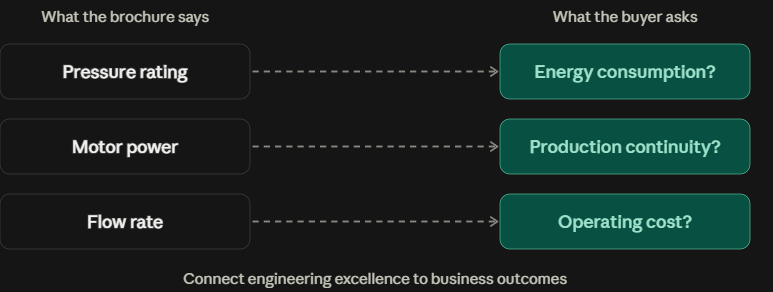
The opportunity is to connect engineering excellence with business outcomes.
Instead of simply explaining what a product does, brands need to communicate why it matters to the people who use it.
When every brand promises efficiency, differentiation matters
Consider the industrial compressed-air market. Manufacturers such as ELGi Equipments, Atlas Copco, and Ingersoll Rand operate in a category where energy efficiency, reliability, and lifecycle costs are important considerations.
These benefits matter, but they are not automatically differentiators.
A more compelling marketing approach would demonstrate how a solution addresses a specific customer’s requirements, supported by relevant technical information and credible evidence.
For example, rather than relying exclusively on a broad promise of better performance, a brand could develop communication around three areas:
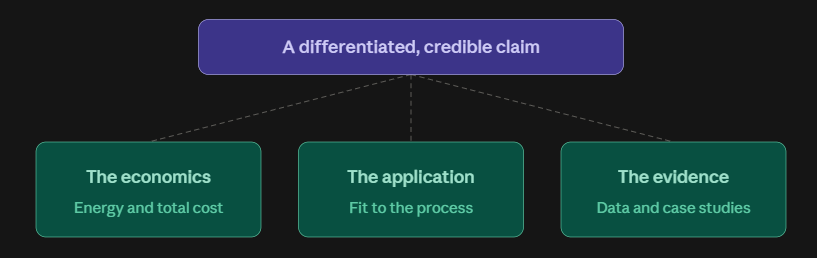
- The economics: Explain the factors influencing energy consumption and total cost of ownership.
- The application: Show how the technology supports a particular manufacturing process.
- The evidence: Present validated performance data, customer experiences, and relevant case studies.
The goal isn’t to abandon technical detail. It’s to make technical detail more meaningful.
From selling machines to communicating value
Imagine an industrial compressor featured in a conventional product advertisement. The visual highlights its design, specifications, and technical features.
Now imagine a different approach.
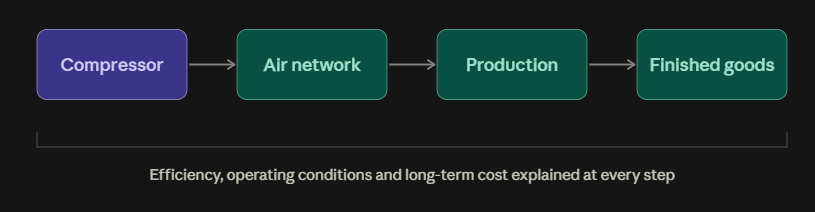
The compressor becomes the starting point for a visual story that follows compressed air through a manufacturing facility, connecting the technology to the processes it supports. Supporting content explains efficiency, operating conditions, and the factors that influence long-term costs.
The product remains central, but the audience gains a clearer understanding of its role in the larger operation.
This shift creates opportunities for more effective industrial communication through:
1. Industry-specific storytelling
A textile manufacturer, an automotive supplier, and a food-processing facility have different operational requirements. Content that reflects these differences can make a brand’s expertise more relevant to each audience.
2. Technical content made accessible
CGI animation, simplified diagrams, product explainers, and visual demonstrations can help communicate complex engineering concepts without oversimplifying the underlying technology.
3. Evidence-led thought leadership
Research reports, expert interviews, industry articles, and LinkedIn content can help brands contribute useful perspectives to conversations their customers already care about.
4. Consistent brand positioning
A clear central message should connect product campaigns, websites, exhibition displays, sales presentations, and thought leadership. Consistency helps buyers understand what the brand stands for and why it deserves consideration.
Why thought leadership matters in B2B marketing
Industrial buyers need more than promotional material. They need information that supports their decisions.
A well-researched article on compressed-air efficiency, an expert interview on industrial energy management, or a practical guide to evaluating lifecycle costs can provide value before a sales conversation begins.
This is where thought leadership becomes a strategic tool.
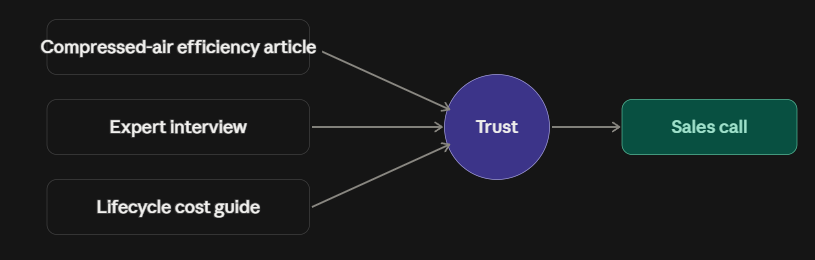
Rather than repeatedly promoting products, brands can demonstrate their understanding of the challenges facing their customers. Over time, useful and credible content can support trust, strengthen positioning, and create more meaningful engagement with prospective buyers.
The key is substance. Thought leadership should offer genuine insight, backed by expertise and evidence, rather than simply repackage promotional claims.
The role of creative communication
Strong industrial marketing doesn’t require choosing between technical accuracy and compelling creativity.
It requires both.
Product CGI can make complex machinery easier to understand. Brand films can connect engineering capabilities with real-world applications. Exhibition graphics can communicate a value proposition in seconds. Well-designed reports and articles can turn research into information that decision-makers want to engage with.

Each format has a different role, but they should work together to communicate a consistent brand story.
The creative challenge is to simplify the message without losing the substance.
A more meaningful approach to industrial branding
Industrial brands already invest heavily in engineering, product development, and customer support. Their marketing should communicate the value of those investments with the same level of thought and precision.
That begins with asking better questions:
- What makes our solution meaningfully different?
- Which customer problem do we understand particularly well?
- Can we demonstrate our value with credible evidence?
- Does our content speak to the buyer’s priorities?
- Is our positioning consistent across every customer touchpoint?
The answers can form the foundation of a more distinctive and effective marketing strategy.
Beyond the machine
At SparkPro Creatives, we believe industrial marketing has an opportunity to move beyond specifications and generic claims.
By combining strategic thinking, research-led storytelling, technical visuals, and consistent creative execution, brands can make complex capabilities easier to understand and their value easier to communicate.

Because the strongest industrial brands don’t just explain what their machines do.
They help customers understand what those machines make possible.
SparkPro Creatives helps brands translate complex products, technologies, and ideas into meaningful visual communication, content, and marketing experiences.
Frequently Asked Questions
1. What services does SparkPro Creatives offer?
SparkPro Creatives offers end-to-end creative and marketing solutions, including branding, marketing collateral, social media creatives, CGI and product visualization, website development, content development, campaign mailers, product packaging, exhibition graphics, and digital marketing support.
2. Can SparkPro Creatives support both digital and traditional marketing?
Yes. SparkPro Creatives creates communication across digital and traditional channels, including social media, websites, email campaigns, brochures, press advertisements, product catalogues, exhibition displays, and other marketing materials.
3. Does SparkPro Creatives work with B2B and industrial brands?
Yes. SparkPro Creatives can help B2B and industrial businesses communicate complex products and services through technical visuals, product films, CGI, industry-focused content, sales collateral, and brand communication.
4. Can SparkPro Creatives help develop our brand identity?
Yes. From logo development and visual identity to brand guidelines, messaging, and marketing collateral, SparkPro Creatives can help businesses establish a consistent and recognizable brand presence.
5. Does SparkPro Creatives create CGI and product videos?
Yes. SparkPro Creatives can develop CGI product visuals, 3D animations, product explainers, and promotional films to demonstrate product features, simplify complex concepts, and create engaging visual experiences.
6. Can SparkPro Creatives design exhibition stalls and event materials?
Yes. SparkPro Creatives can support exhibition and event communication with stall graphics, backdrops, standees, posters, brochures, digital invitations, and promotional content.
7. Does SparkPro Creatives provide content marketing and thought leadership?
Yes. SparkPro Creatives can support content development through articles, blogs, LinkedIn posts, campaign copy, industry-focused storytelling, and other formats designed to communicate expertise and strengthen brand credibility.
8. Can SparkPro Creatives work with our in-house marketing team?
Yes. SparkPro Creatives can collaborate with in-house marketing teams to support specific campaigns, recurring creative requirements, product launches, exhibitions, and ongoing brand communication.
9. Can we start with a small project before committing to a larger engagement?
Yes. Businesses can discuss a pilot project with SparkPro Creatives to evaluate the creative
Leave a Reply